
MoMA After Hours: Dancing Before Berl-Berl at the Taking Back Our Space Party
On November 17, MoMA After Hours turned the Agnes Gund Garden Lobby into a dance floor before Jakob Kudsk Steensen’s Berl-Berl, inspired by the exhibition Taking Back Our Space.
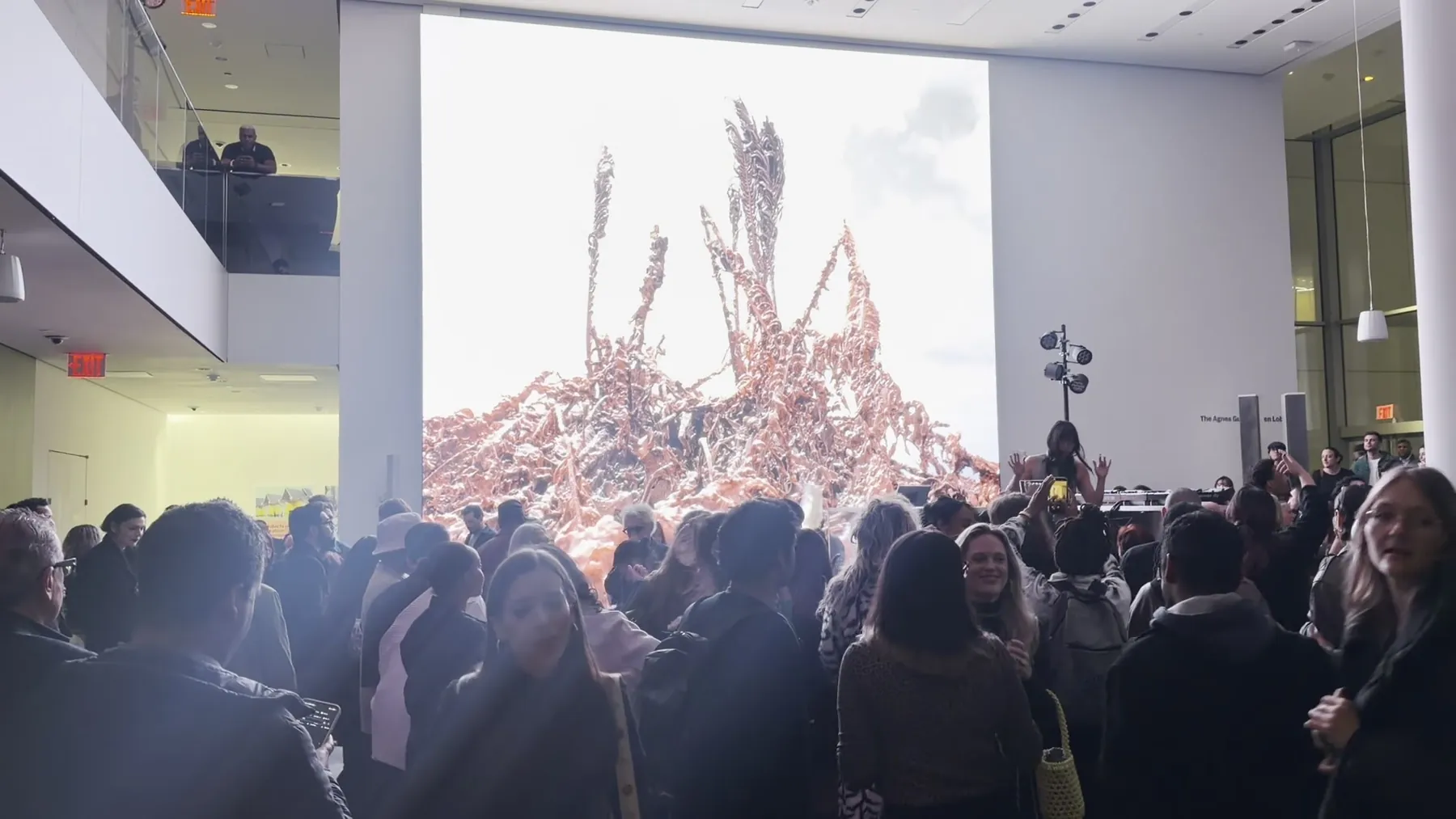
For three hours on Tuesday, November 17, the Museum of Modern Art turned its ground floor into a dance floor. An illuminated sign by the doors read "MoMA After Hours" and "Taking Back Our Space," and inside the Agnes Gund Garden Lobby a crowd danced under violet light around a DJ booth. Behind it, on a wall-height screen, Jakob Kudsk Steensen's digital wetland slowly turned through moss, roots, water and pink tendrils.
The evening was MoMA After Hours: Taking Back Our Space, a ticketed party from 7 to 10 p.m. that the museum described as an evening of art, movement, music and collective expression inspired by its photography exhibition Taking Back Our Space: Photographic Perspectives. It took place five days after a very different MoMA night, the Film Benefit honoring Steven Spielberg on November 12. This one had no seated dinner or award, only bars, performances, open galleries and a DJ. The Circuit Report's stills and short films from the night, below, move from the dance floor to the lobby bars and out into the sculpture garden.
A digital wetland as a dance floor
The party was built around the largest artwork in the lobby. Jakob Kudsk Steensen: Wetland, on view in the Agnes Gund Garden Lobby from October 12, 2026, to March 7, 2027, consists of a single work, Berl-Berl, a real-time simulation of moving image and sound that the Danish artist has kept changing since 2021. Smithsonian magazine reported that the piece grew out of the lost swamps around Berlin. It is built from macro photogrammetry and game-engine software, using research made with the city's natural history museum, and its soundtrack layers altered field recordings of amphibians and water with human voices, among them the Venezuelan musician Arca's. Berl-Berl debuted in 2021 at Berghain, the Berlin nightclub in a former power plant. Smithsonian quoted the artist saying that at MoMA the work is "made to envelop you" with "a sense of … dance."
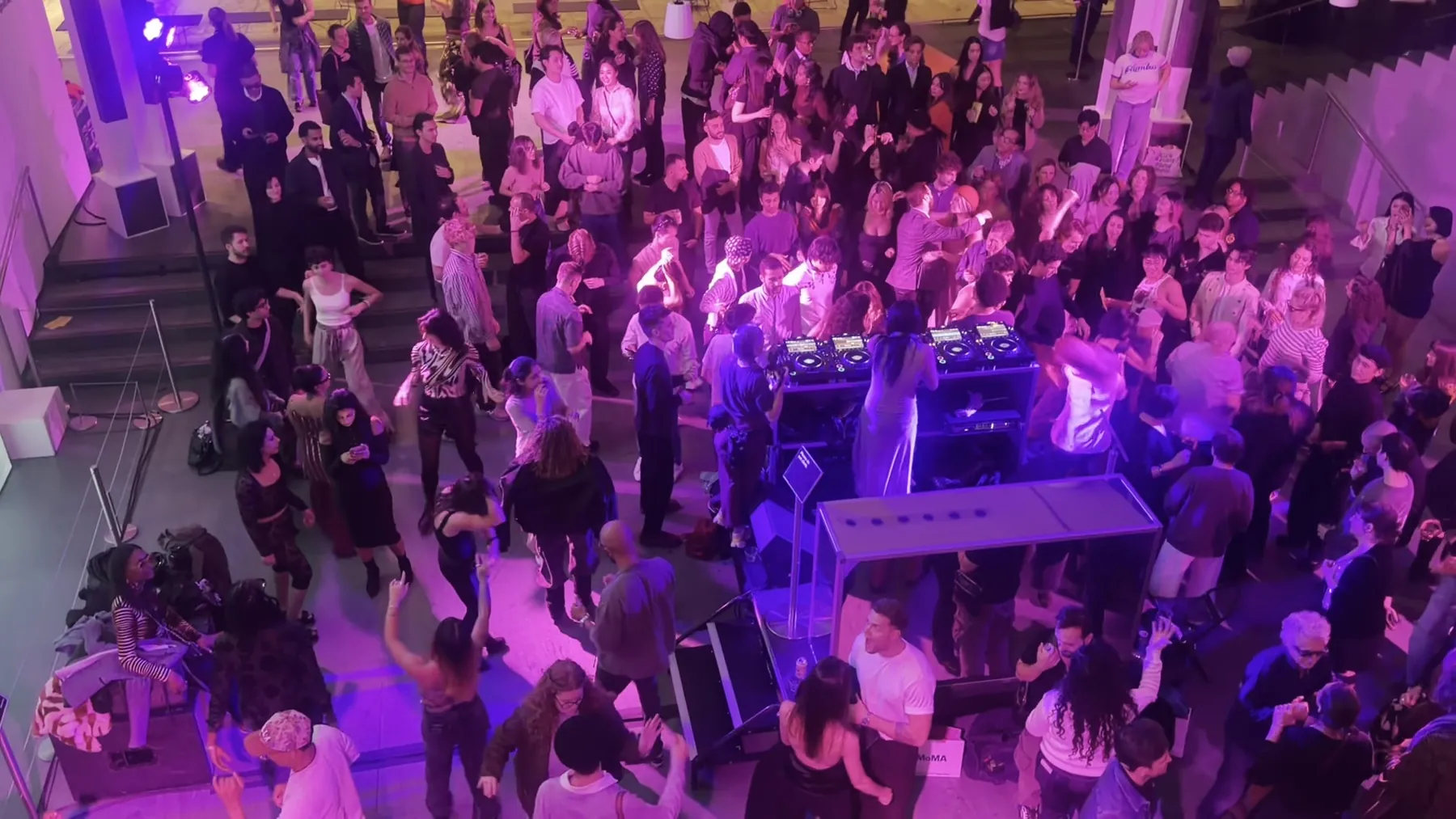
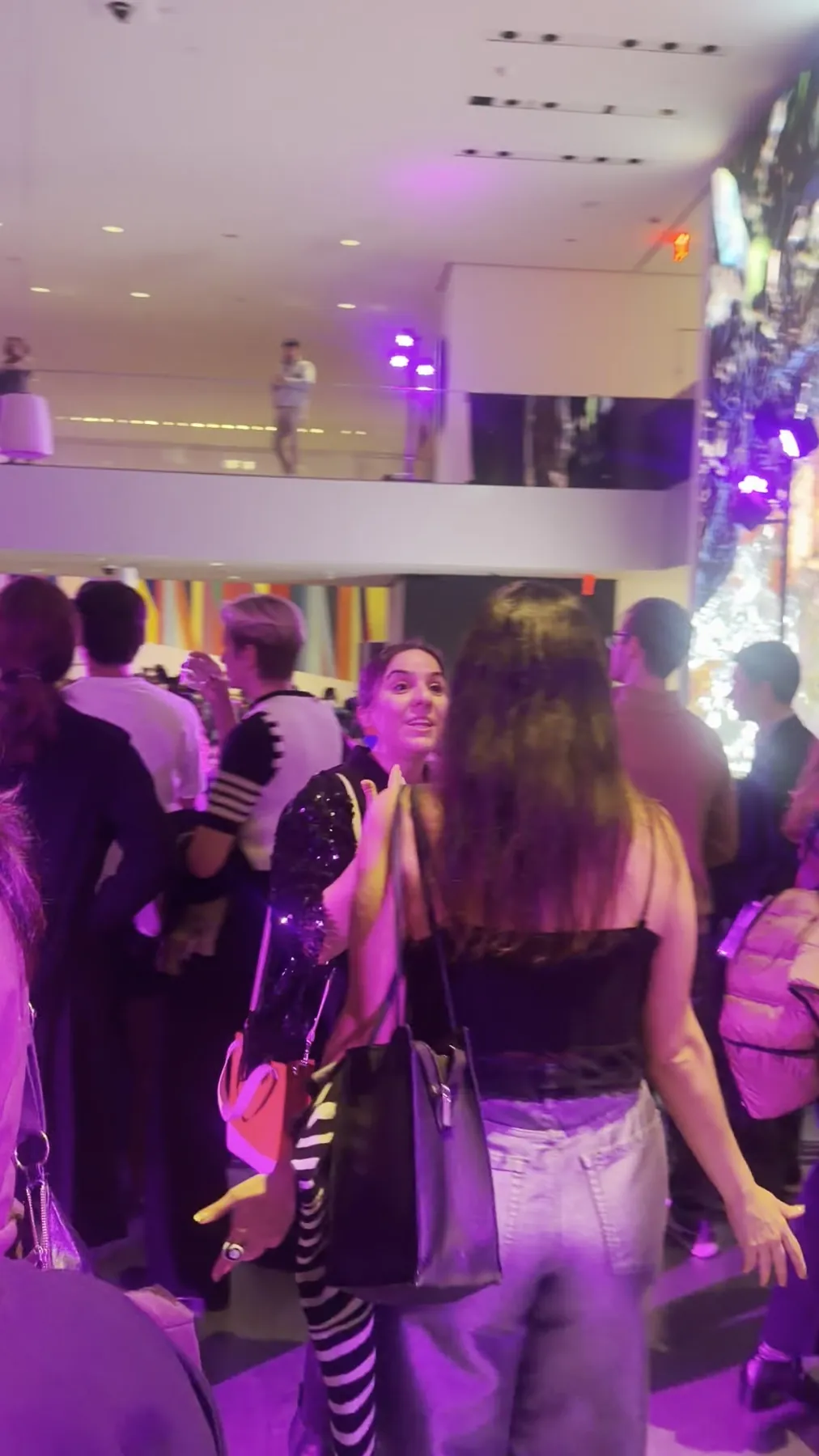
On November 17 it did. From the balcony the scene below was dense: two pairs of decks on a lit platform, a MoMA sign at its foot, and a crowd packed to the edges of the stairs. At floor level the screen rose above the dancers, and the lobby's tall glass wall behind the booth caught the purple lights. Guests lined the balcony rail to watch, and others carried drinks from pop-up bars toward the music. Along the lobby walls the hard-edged color stripes of Odili Donald Odita's Songs from Life, the site-specific commission that covers the lobby's walls and columns with geometric color, made a bright background for the party.
Outside, the Abby Aldrich Rockefeller Sculpture Garden stayed open into the night. Guests sat on the garden steps and in its wire chairs beside the pools, away from the volume indoors.
The program
The evening took its name and theme from the exhibition Taking Back Our Space, and our films show how it played out after dark: a DJ set beneath Berl-Berl in the Agnes Gund Garden Lobby, a dance floor that filled the lobby, a busy pop-up bar, and the Abby Aldrich Rockefeller Sculpture Garden lit for guests late in the night. MoMA's After Hours series pairs the museum's current exhibitions with music, performance and galleries kept open after closing, and the museum's own calendar carries the full program for each edition.
MoMA After Hours, November 17
Stills and short films from MoMA After Hours: Taking Back Our Space on November 17, 2026: the dance floor in the Agnes Gund Garden Lobby before Jakob Kudsk Steensen's Berl-Berl, the lobby bars and the Abby Aldrich Rockefeller Sculpture Garden after dark.
Inside the museum after hours
A DJ set in front of Jakob Kudsk Steensen's Berl-Berl in the Agnes Gund Garden Lobby, November 17, 2026. With the DJ's music. Open video
From the projection to the dance floor by the glass wall onto the sculpture garden, November 17, 2026. With the DJ's music. Open video
The illuminated sign for the evening at the museum's entrance, November 17, 2026. With the music from the lobby. Open video
Guests at a bar in the lobby, with the projection and Odili Donald Odita's painted wall behind, November 17, 2026. With the room's music. Open video
Guests on the steps and among the chairs of the Abby Aldrich Rockefeller Sculpture Garden, November 17, 2026. With the garden's ambient sound. Open video
The exhibition behind the party
Taking Back Our Space: Photographic Perspectives opened on September 20, 2026, in the second-floor Paul J. Sachs Galleries and runs through May 2, 2027. Its anchor is a single, enormous work: Marianne Wex's Let's Take Back Our Space: "Female" and "Male" Body Language as a Result of Patriarchal Structures (1977), which MoMA acquired in its entirety in 2018.
Wex, born in Hamburg in 1937, studied and taught at the city's Hochschule für bildende Künste and first used photography to document her paintings. According to the museum's announcement, from 1972 to 1977 she photographed men and women on Hamburg's streets, recording exactly how they placed their arms, legs, feet, hands and heads. She rephotographed advertisements, fashion magazines, newspapers, studio portraits, film and television stills, and a world history catalogue of figurative sculpture. She then sorted the images by gender into categories such as "Standing Arms," "Seated Legs" and "Possessive Holds," mounting thousands of gelatin silver prints and her own analysis on nearly 250 boards. The result shows, sequence after sequence, how differently men and women had been taught to occupy space.
The exhibition is organized by Roxana Marcoci, the David Dechman Senior Curator of Photography, with assistant curator Caitlin Ryan. In the announcement, Marcoci called Wex's survey "an epic visual archive, a feminist version" of art-historical catalogues such as Aby Warburg's Mnemosyne Atlas, and said that "its project of identifying and unlearning prejudicial forms is as relevant as ever in the 21st century." Speaking to The Art Newspaper, which reviewed the show at its opening, she said the contemporary artists "expand that inquiry through intersectional perspectives attentive to race, colonialism, Indigenous sovereignty, sexuality and self-representation."
Seven artists in dialogue
Around Wex, the galleries hold recent works by seven artists, each shown at MoMA for the first time. In a 2013 self-portrait, the late Nona Faustine presses against a marble column of the Tweed Courthouse in Lower Manhattan, steps from the African Burial Ground. Martine Gutierrez is represented by her art book-turned-magazine Indigenous Woman (2018). K8 Hardy, a founder of the feminist and queer collective and journal LTTR, shows her Position Series (2007–12), an inventory of self-transformations. Joiri Minaya's Divergences collages show women escaping bodysuits printed in commodified tropical patterns. Yuki Kihara's Paradise Camp (2020) restages Gauguin's Polynesia with Samoan fa'afafine models. Paulina Olowska's Body Movement – Alphabet Studies (2007) turns found photographs of bodies into letters, and Wendy Red Star's Accession series (2019) pairs 1930s museum drawings of Native objects with her photographs from the Crow Fair.
The connection to the party was direct. An exhibition about who is allowed to take up public space became a night in which a museum lobby belonged to dancers.
MoMA After Hours
MoMA After Hours is the museum's ticketed evening party series, separate from its free UNIQLO Friday Nights and its member evenings. The previous edition, Wanderlust on October 6, featured a performance by L'Rain and a DJ set by Alexis De La Rosa with the dancer Lysis, according to the museum's own post. Taking Back Our Space followed the same plan: one exhibition as the theme, artists invited to respond to it, and the museum open late on a weeknight. Upcoming editions appear on the After Hours program page.
Keep reading

Art & Culture · New York
Taryn Simon After Hours: The Guggenheim’s October Member Monday
The Guggenheim’s October 19 Member Monday has passed, but Taryn Simon’s exhibition runs through March 14, 2027, and membership makes time to see it.

Museums · New York
Siena in Bronze, After Hours: The Frick’s Member Evening
On Monday, October 26, The Frick Collection scheduled a members’ evening viewing of its new exhibition of fifteenth-century Sienese bronzes, an unhurried encounter with Donatello, Vecchietta and…
Museums · New York
After Hours at the Frick: A Member Evening With Siena’s Bronzes
On Saturday, October 24, the Frick Collection scheduled an after-hours evening for members only, with sketching in the Garden Court, educator talks and the new Siena bronze exhibition on view.